1700s
1700 Protestant nations in Western Europe, except England, start using the Gregorian calendar.
1701 Kingdom of Prussia declared under King Frederick I.
1701–1714  The War of the Spanish Succession involves most of Europe. The War of the Spanish Succession involves most of Europe.
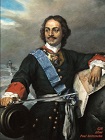
1703 Peter the Great founds Saint Petersburgas the capital of Russia
1707 The Acts of Union merges the Scottish and English Parliaments
1709 Peter I of Russia defeats Charles XII of Sweden at Battle of Poltava.
|
1710s
1710 Anglo-Irish philosopher George Berkeley published A Treatise Concerning the Principles of Human Knowledge, which claimed reality is constructed entirely of immaterial, conscious minds and their ideas, including the mind and ideas of God.
1712 The Pennsylvania assembly restricts slavery with duties and other laws.
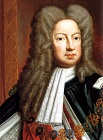
1714 King George I from Hanover, Germany succeeds his cousin Queen Anne.
1714 Daniel Fahrenheit invents the mercury-in-glass thermometer
1715 Jacobites unsuccessfully attempt to restore the House of Stuart to the British throne.
1716–1718 Austro-Turkish War.
1718: The city of New Orleans is founded by the French in North America.
|
1720s
1720 The South Sea Bubble.
1723 Slavery is abolished in Russia; many slaves become serfs.
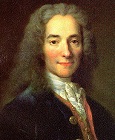
1726-28 Voltaire in exile in Great Britain
1728 French establish a trading post in Canton, China.
1729 - Benjamin Franklin begins publishing The Pennsylvania Gazette.
The London Gin Craze
1729 Chinese Imperial decree banning sale of opium.
|
1730s
1730–1760 The First Great Awakening starts in Great Britain
1731 The first American public library is founded in Philadelphia by Benjamin Franklin.
1732–1734: Crimean Tatar raids into Russia
1733–1738 War of the Polish Succession.
1735–1739 Austro-Russo-Turkish War.

1735–1799 Emperor Qianlong of China oversees a huge expansion in territory.
1738–1756: Famine across the Sahel; half the population of Timbuktu dies.
1739 Great Britain and Spain fight the War of Jenkins' Ear in the Caribbean.
|
1740s
1740–1741 Famine in Ireland kills 20 percent of the population.
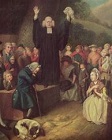
1740 George Whitefield spreads the First Great Awakening to New England
1740–1748 War of the Austrian Succession.
1742 Marvel's Mill, the first water-powered cotton mill in England.
1742 Anders Celsius proposes the 1st version of his centigrade temperature scale.
1744 Emanuel Swedenborg was an accomplished scientist and inventor from Sweden who wrote 18 theological books after a "spiritual awakening" in 1744. His book on the afterlife, Heaven and Hell (1758) was the most popular, and his concept of the Divine Trinity within Jesus vs the Trinity of Persons was the most controversial.
1747 French physician and materialistic philosopher Julien Offray de La Mettrie publishes Man a Machine in which he concluded the human mind and soul were not separate from our physical bodies. His views were so controversial that he had to flee France and settle in Berlin.
1748 Montesquieu anonymously published The Spirit of Law, in which he analyzed and compared governments, and introduced concepts like the separation of powers that would influence many future constitutions.
|
1750s
1750 Peak of the Little Ice Age.
1751 Scottish philosopher David Hume publishes Principles of Morals in which he claims
morality is not the result of human reason. He is also known for arguing that belief in causality is derived from custom and mental habit.
1751 British troops under Robert Clive defeat the French and establish Great Britain as the leading colonial power in India.
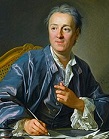
1752-72 Denis Diderot is chief editor of the Encyclopédie published in France
1756 Frederick II of Prussia invades Saxony, starting the Seven Years' War, a world-wide
war fought in Europe, North America, and India, pitting France, Austria, Russia, Saxony,
Sweden and Spain against Prussia, Great Britain and Hanover.
1757 Benjamin Franklin invents the lightning rod
1757 Frederick II of Prussia defeated by Austrians at Battle of Kolín (Seven Years' War).
1757 British defeat French at Battle of Plassey (Seven Years' War), permitting British a foothold in
Bengal.
1759 Siege of Quebec.
1759 French philosopher Claude Adrien Helvétius was a student and leader of the Enlightenment. His original ideas are those of the natural equality of intelligences and the omnipotence of education.
|
1760s
1760 Russian General Gottlob Tottleben captures Berlin.
1762 Swiss philosopher Jean-Jacques Rousseau publishes The Social Contract which outlines the evolution of society and how humans can regain their freedom through agreement on enlightened laws.
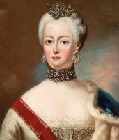
1762–1796 Reign of Catherine the Greatof Russia.
1763 Treaty of Paris ends Seven Years' War; British gain Canada and India
1763 Proclamation line of 1763
1765 Scottish engineer James Watt, after repairing a 1712-model Newcomen engine, designed a much improved steam engine. It would take over a decade for Watt and his partner to build a profitable manufacturing business. The international unit of power, the "watt" was named after him because of his concept of horsepower.
1765 The Stamp Act taxed all paper used in the American colonies.
1769-83 21 Spanish missions established in California.
|
1770s
1775 British soldiers exchange gunfire with colonial militia at Lexington, Massachusetts,
then proceed to Concord where they destroy colonial munitions, and then engage in another skirmish. Colonial soldiers are killed, beginning the American Revolutionary War.
1775 American colonists repulse two British assaults, but finally are pushed from Breed's
Hill in Boston, (Battle of Bunker Hill). However, the British fail to break the colonists'
siege of Boston.
1774 Ann Lee (1736-1784) was a
Shaker
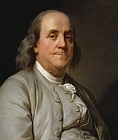 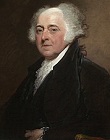 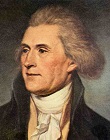 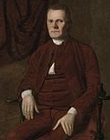 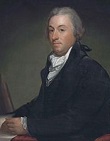
1776 Declaration of American Independence is drafted by the Committee of Five.
1777 Articles of Confederation
1778 French declare war on British (Treaty of Alliance).
1778 French chemist Antoine Lavoisier discovers the role of oxygen in combustion and names the element. He later discovered other elements and the law of conservation of mass. Lavoisier was beheaded in 1794 during the Reign of Terror.
1746-80 French priest Condillac wrote about the philosophy of the mind, most famously on the origin of human knowledge and sensation. Condillac considered language as the vehicle by which senses and emotions were transformed into higher mental faculties.
|
17
1780s
1780 American General Benedict Arnold, Commander of fort at West Point, New York, plots to surrender the fort to British. The plot is discovered, and Arnold defects to the British.
1781 German Immanuel Kant, the "father of modern philosophy" publishes the 1st edition of the Critique of Pure Reason. Kant believed that reason is the source of morality, but that human experience is understood through intuition. The limits of human knowledge are why we need hope and faith to be free.

1781 British Commander Lord Cornwallis surrenders at Yorktown, VA to American George Washington.
1782 British House of Commons passes motion to end the American Revolutionary War.
1783 Joseph and Jacques Montgolfier perform a 10-minute hot air balloon flight in France.
1786 Shays's Rebellion against tax collectors challenges the Articles of Confederation.
1787 U.S. Constitution is ratified in September. The The Federalist Papers are written during the following six months to address criticisms of it.
1787 The power loom was invented by English Edmund Wright, a key development in the early Industrial Revolution.
1789 Unruly crowd in Paris storms the Bastille Castle, starting the French Revolution.
Issuance of the Declaration of the Rights of Man. |
1790s
1789-1805 Haitian Revolution began as a revolt led by Toussaint Louverture
1790-1840 Second Great Awakening
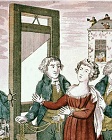
1793 French King Louis XVI and Queen Marie Antoinette are beheaded by guillotine.
1794 American inventor Eli Whitney patents the cotton gin.
1794 After leading the Reign of Terror, Jacobin leader Robespierre is executed.
1795 Constitution establishes The Directory to govern the First Republic of France.
1796 - 97 George Washington's Farewell Address warns against foreign entanglements
1796 Napoleon victorious at Arcole & Rivoli, Italy
1798 Napoleon defeats Mamelukes at the Battle of the Pyramids, in Egypt.
1798 In the Battle of the Nile, British Admiral Horatio Nelson surprises the French navy
at anchor in Aboukir Bay. The battle is joined as the sun set, and is fought by the light
of burning ships. When the sun rises on August 2, Nelson later said, "Victory is not
a name strong enough for such a scene."
1799 After 8 years of development, the metric system is launched in France.
1799 Napoleon takes control of France.
French soldiers discover the Rosetta Stone.
1799 Italian physicist Alessandro Volta invents the first electric battery. The volt, a unit of measurement regarding the strength of an electric current, was named in his honor in 1881
|