1900s
1900 The Brownie camera is invented and popularized by Eastman Kodak
1901 Ferdinand von Zeppelin builds the first successful dirigible.
1901 The first radio receiver was developed by Guglielmo Marconi.
1902 Air conditioner is invented by Willis Carrier
1903  The Wright brothers of Ohio develop the first powered plane. The Wright brothers of Ohio develop the first powered plane.
1903 The Great Train Robbery silent film is a huge success
1903 Germany and the Ottoman Empire begin construction of the Baghdad railway, which would give Germany access to oil reserves needed by Great Britain.
1904-1905 Russo-Japanese War
1905 Revolution breaks out in Russia after Bloody Sunday.
1905 Sinn Féin Irish independence movement begins.
1907 The Triple Entente btw Great Britain, France, and Russia formed to counter the threat posed by the Triple Alliance of Germany, Italy, and Austria-Hungary.
1908 British geologists discover oil in Persia (Iran), establishing the Anglo-Persian Oil Company
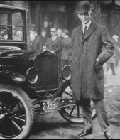
1908 The Ford Motor Company begins to produce the Model T.
1909 The National Association for the Advancement of Colored People (NAACP) is formed as an interracial endeavor to advance justice for African Americans
|
1910s
1910 The Mexican Revolution begins, when Francisco Madero proclaims the elections null and void, and calls for an armed revolution.
1911 Revolution in China ends the Qing Dynasty and led to the establishment of the Republic of China the following year.
1912 The British Titanic ocean liner sank as a result of striking an iceberg on her maiden voyage.
1913 The Federal Reserve was created and the 16th Amendment authorizes income taxes.
1914 The Panama Canal completed
1914-18 World War I ends the Russia, German, Ottoman, and Austria-Hungar empires.
1915 German submarine torpedoed the British liner Lusitania
1917 U.S. declares war on Germany after Zimmerman telegram.
1917 The Espionage Act silences public opposition of U.S. military operations.
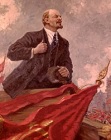
1917 Russian Revolution begins, Tsar Nicholas II abdicates
1918 Women over thirty win right to vote in Britain
1919 18th Amendment prohibits the sale of alcohol in U.S.
1919 The Sinn Fein declares Ireland a Republic
1919 Treaty of Versailles reconstitutes Poland as a nation and gives Weimar Republic power in Germany
|
1920s
1920 19th Amendment to the U.S. Constitution, gives women the right to vote.
"Jazz Age" flappers break taboos
1920 The League of Nations created
1921 The Chinese Communist Party (CCP) is founded.
1921 Tulsa Race Riots undermine the racial ideals of 20th Century American Society.
1922 Irish Free State gains independence from the United Kingdom.
1923 Beer Hall Putsch fails and Adolf Hitler is imprisoned where he writes Mein Kampf
1924 Immigration Act places restrictions on immigration
1925 The Scopes trial declared that John T. Scopes had violated the law by teaching evolution in schools
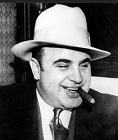
1925-31 Gangster Al Capone was boss of the Chicago Outfit
1926 Robert Goddard launches the world's first liquid-fueled rocket.
1927 Charles Lindbergh flies across the Atlantic Ocean.
1927 Civil War begins in China (first phase 1927–1936)
1928 Kellogg-Briand Pact, an agreement "to renounce war as an instrument of national policy," was signed in Paris by 15 nations
1929 New York Stock Market crashed.
|
1930s
1930 Mahatma Gandhi leads the non-violent Satyagraha movement in the Declaration of the Independence of India and the Salt March
1931 Japan captures Manchuria, creating the puppet state of Manchukuo, with Puyi, the last Qing dynasty Emperor of China, as the nominal ruler.
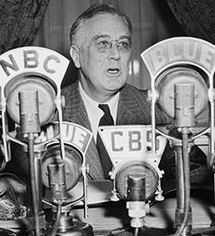
1933 U.S. President Franklin D. Roosevelt enacts New Deal legislation
1933 Adolf Hitler becomes Chancellor of Germany.
1934 The Chinese Red Army begins the Long March in retreat from the Nationalists.
1935 to 1936 Ethiopia is invaded by Italy during the Second Italo-Ethiopian War.
1936-39 The Spanish Civil War between the Nationalists under Francisco Franco and the Republicans, an alliance of various socialist, communist, separatist, anarchist, and republican parties.
1937 Snow White and the Seven Dwarfs was the highest-grossing film of the 1930s.
1937 English engineer Frank Whittle tested the first jet engine on the ground.
1938 Austria annexed by Germany in the Anschluss
1938 Ceding of Sudetenland (German-speakers) from Czechoslovakia to Germany is agreed to by the British (Neville Chamberlain) and the French.
1939 World War II begins when Germany and the Soviet Union invade and partition Poland.
1939 Canada, Cuba, and the United States controversially deny asylum to hundreds of German Jewish refugees from Nazi Germany.
|
1940s
1940 The Soviet Union NKVD massacres Polish military officers at Katyn Forest
1941 Germany invades the Soviet Union in Operation Barbarossa.
1941 U.S. declares war on Germany after Japan attacks Pearl Harbor.
1942 After his Golden Hour radio broadcast is shut down, Father Coughlin's criticism of the Roosevelt administration finally ends when his newspaper Social Justice ceases publicationn.
1942 to 1946 The U.S. collaborates with Canada and Great Britain to research, develop and produce the first nuclear weapons in the Manhattan Project.
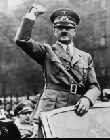
1944 German military attempt to assasinate Adolf Hitler and disarm his regime in Operation Valkyrie.
1945 After Hitler's suicide, the Germans surrender on May 8th, Victory in Europe Day.
1945 The US dropped the first atomic bombs on Hiroshima on August 6th and on Nagasaki on August 9th. Japan formally surrendered on September 2nd, Victory over Japan Day.
1945 The United Nations is established after World War II to prevent future world wars,
1945-1975 House Un-American Activities Committee becomes a standing (permanent) committee and convicts the "Hollywood Ten" of contempt of Congres in 1947 and Alger Hiss of perjury in 1948.
1948 Declaration of the Establishment of the State of Israel is followed by the Arab–Israeli War
1949 Mao Zedong declares The People's Republic of China
|
1950s
1950–1953 The Korean War results in a stalemate after President Truman relieved General MacArthur of his command in 1951 .
1953–1959 Cuban Revolution brings Fidel Castro to power
1954 The 1st Nuclear Power Plant is connected to the power grid southwest of Moscow.
1954 Senator Joseph McCarthy's investigation of Soviet espionage agents (McCarthyism) loses populatity after a television broadcast of his hearings regarding subversion in the the U.S. Army.
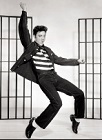
1955 Elvis Presley first appears on TV, and begins to popularize Rock and Roll
1956 Hungarian Revolution begins with university students protesting and then civil militias joining them over the next 12 days before being crushed by Soviet Union tanks.
1956-1975 32 African countries gained independence from their European colonial rulers.
1957 First artificial satellite Sputnik 1 put into orbit by the Soviet Union
1958 The US founds NASA (National Aeronautics and Space Administration)
1958-62 China's Great Leap Forward results in famine with estimates of 15 to 55 million deaths.
1959 Nikita Khrushchev visits the U.S.A.
|
1960s
1960 Eisenhower's farewell address warns of the influence of the
military–industrial complex
1961 The Berlin Wall is constructed to prevent East Germans from escaping to the West.
1962 A crisis arises when the Soviet Union deploys missles in Cuba in response to U.S. deploying missles in Italy and Turkey in 1961.
1963 President John F. Kennedy is assassinated.
1964 The U.S. Congress passes the Gulf of Tonkin Resolution giving President Johnson authorization to use military forces in Vietnam.
1964 Young adults in the U.S. embrace the growing Counterculture following the Civil rights movement and disagreement with the Vietnam War. Anti-establishment sentiments affect music, fashion, drug-use and lifestyles which spread to other countries.

1965 Cassius Clay changes his name to Muhammad Ali and knocks Liston out in the 1st round.
1966 Mao Zedong launches the Cultural Revolution to purge capitalist and traditional ideas from Chinese society.
1967 Israel launched a series of preemptive airstrikes against Egypt starting the Six-Day War after the Straits of Tiran are closed to Israeli shipping.
1968 Martin Luther King Jr. is assassinated in April and so is
Robert F. Kennedy in June.
1968 The economy of France comes to a halt after trade unions join protests started by students.
1969 Apollo 11 is the first of six successful moon missions; the last is in 1972.
|
1970s
1970 The Soviet Union lands Lunokhod 1, the first roving remote-controlled robot, on the Moon.
1971 Gloria Steinem, the leader of second-wave feminism in the US, founds the National Women's Political Caucus and the Women's Action Alliance.

1972 Hardline anti-communist Richard Nixon visits Mao Zedong in Communist China.
1973 Yom Kippur War was launched by Egypt and Syria against Israel to recover territories lost in the Six-Day War. The Israelis eventually managed to repel the Egyptians ending the conflict in 1978.
1974 Isabel Perón becomes the first woman president of Argentina.
1975 The Vietnam War ends with the fall of Saigon and the unconditional surrender of South Vietnam. The following year, Vietnam was officially declared reunited.
1975 Bill Gates and Paul Allen found Microsoft to develop and sell BASIC interpreters for the Altair 8800. It rose to dominate the pc operating system market with MS-DOS in the mid-1980s,
1976 Steve Jobs and Steve Wozniak found and incorporate the Apple Computer Company.
1976-79 The Bump and the Hustle dances help to make Disco music popular.
1977 The home video game console Atari 2600 is released and popularized microprocessor-based hardware and games stored on swappable ROM cartridges.
1978 San Francisco Mayor George Moscone and Supervisor Harvey Milk are assassinated by disgruntled former Supervisor Dan White.
1979-1981 Iranian college students took over the U.S. Embassy in Tehran and take 53 Americans hostage. They are released when President Reagan was sworn in, prompting the national security adviser and others to accuse the Reagan campaign of conspiring to delay their release.
|
1980s
1980s British decolonization continues with Zimbabwe in 1980, the Canada Act in 1982, the Australia Act in 1986 and New Zealand's Constitution Act in 1986.
1980 Former actor and California governor Ronald Reagan defeats Jimmy Carter.
1981 MTV (Music Television) is launched as an American cable channel, changing the way music is marketed.
1981-84 Personal Computers, like the IBM Personal Computer, the Commodore_64 and the Macintosh_128K become popular
1981 The first Space Shuttle is launched. Over the next 30 years, the shuttle would fly 138 missions delivering satellites, interplanetary probes, the Hubble Space Telescope and materials and supplies for the Mir and International Space Stations. Two of the four orbiters were lost in mission accidents: Challenger in 1986 and Columbia in 2003
1981 Reagan and Pope John Paul II are both shot and survive assassination attempts.
President Anwar Sadat of Egypt does not survive assassination.
1982 The Falklands War btw U.K. and Argentina ends American Monroe doctrine.
1985 Russian Glasnost and Perestroika by Mikhail Gorbachev
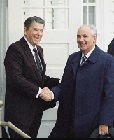
1987 INF (Intermediate-Range Nuclear Forces) Treaty btw U.S. and the Soviet Union
1989 Pro-democracy protesters gather in Tiananmen Square in Beijing to demand political reform and are crushed by the People's Liberation Army.
|
1990s
1990 Microsoft releases Windows 3.0 OS, '92:3.1, '95:95, '98:98
1990 Human Genome Project begins identifying, mapping and sequencing all of the genes of the human genome.
1990-91 The Gulf War begins when Iraq's Saddam Hussein invades Kuwait in response to its oil production policies. A 42-country coalition led by the United States then liberated Kuwait in Operation Desert Storm.
1991 Cold War ends with Boris Yeltsin and Russian liberation of Soviet States
1992-95 Following the breakup of Yugoslavi, the Bosnian War results when Bosnian Serbs reject the referendum for independence by other minority groups. The Yugoslav People's Army secure territory for the Serbs, and Pakistan supplied arms to Bosnian Muslims. NATO joined the conflict in 1995 ending the war 7 months later.
1993 The World Wide Web, becomes
wildly popular when CERN makes the HTTP protocol and code available royalty free and web browsers like Mosaic are released.
1994 In the Rwandan Civil War, almost 1 million Tutsi (minority group) are massacred by Hutus.

1994-1999 Nelson Mandela is President of South Africa
Telecommunications Act of 1996 allows consolidation of media ownership.
1997 UK Handover of Hong Kong to People's Republic of China.
|